
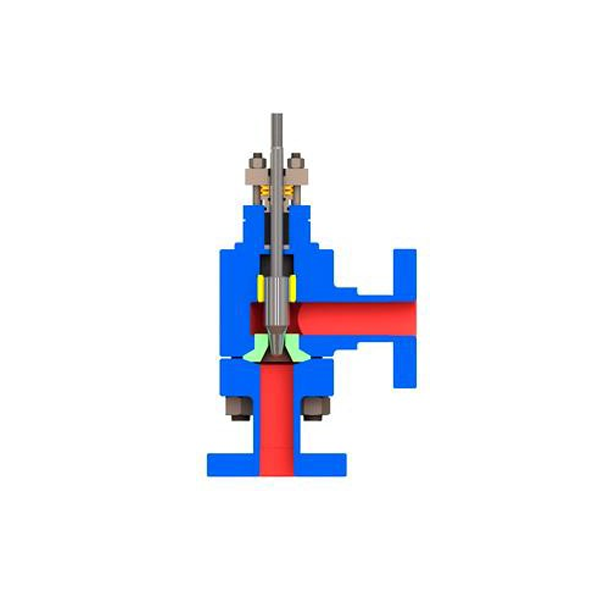
Cage-type angular control valve
Category: Angle Regulating Valve
Product Details
Overview
- The valve features a simple structure, with the valve body's inlet and outlet arranged at a 90° angle. It boasts low flow resistance and high valve capacity, along with a wide adjustability range and highly accurate flow characteristics.
- Due to the angular control valve's dead-corner-free flow passages and straightforward flow path, it features a "self-cleaning" function, making it ideal for applications involving high-viscosity fluids, as well as those containing suspended liquids and particulate matter.
- The angular regulating valve belongs to the single-seat valve category, featuring low leakage. However, since it retains the single-seat design, the larger the diameter, the smaller the allowable pressure difference.
- The flow path is simple and typically used for low-in, side-out configurations, which helps ensure better stability during regulation.
Structural Form
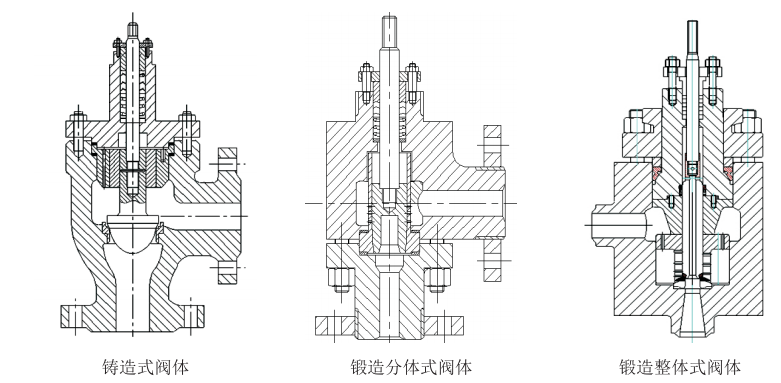
Major Components and Supporting Materials
| Valve |
Components |
Structural Type |
Material |
Note |
| Valve body |
Angular single-seater |
Carbon steel, stainless steel, special alloy steel |
Casting, Forging |
|
| Valve core |
Piston-type, force-balanced valve plug |
Stainless steel, special alloy steel |
Seal surface surfacing and coating |
|
| Valve seat |
O-shaped external thread, sleeve-type |
Stainless steel, special alloy steel |
Seal surface surfacing and coating |
|
| Valve cover |
Room-temperature and heat-dissipation type |
Stainless steel, special alloy steel |
|
|
| Filler |
V-shaped, O-shaped |
PTFE, Flexible Graphite |
|
|
| Sealing gasket |
Serrated, lens-shaped pad |
Stainless steel, special alloy steel |
||
| Executive Agency |
Pneumatic diaphragm multi-spring type, cylinder |
Spring range (kPa): 20–100, 40–200, 80–240, 120–240 |
||
| Input signal (kPa): 150–400; Positioner 4–20 mA DC, 1–5 V |
||||
| All-electronic 3610L, PS Series |
Input signal 4–20 mA.DC, wiring 2-1/2 NPT |
|||
Features
The flow path is simple, with the inlet and outlet arranged at a 90° angle, resulting in low flow resistance and excellent flow capacity—while also inheriting the advantages of cage-type control valves. It is primarily suited for controlling applications involving large pressure differences, high-viscosity fluids, and impure media containing suspended solids or particulates.
Main Technical Parameters
Nominal diameter: DN40–DN200 mm
Nominal pressure: PN1.6–6.4 MPa, ANSI 150–600
Flow characteristics: Linear, equal percentage, quick-opening; Flow coefficient: Cv 11–850
Leakage Level: Class III, Adjustable Ratio R: 50:1
Connection method: Flanged, welded Operating temperature: -29°C to +560°C
Keywords: Cage-type angular control valve
Related Products
Service Hotline
Address: No. 1158, Section 2, Huafu Avenue, Huayang, Shuangliu District, Chengdu City, Sichuan Province, China.
Follow ChuanKai Valves

Right-side online customer service widget
SAF Coolest v1.2 设置面板 GAGSE-ZGYF-JVSVE-ZFF
无数据提示
Sorry, there is currently no content in this section.!
You can view other sections or return toHome Page